Connect(X) Panel Looks Ahead at an Evolving Digital Infrastructure Ecosystem
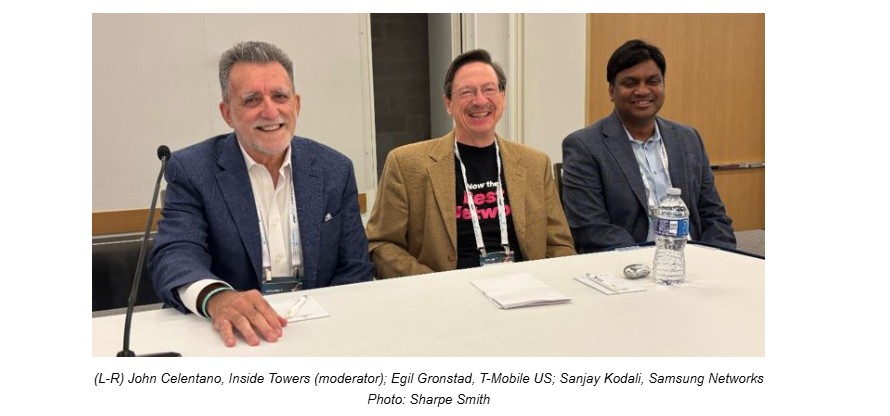
Panel sessions at this year’s WIA Connect(X) produced interesting and informative discussions on a wide range of subjects. One forward-looking discussion titled, “The Evolving Digital Infrastructure Ecosystem: Implications for Network Operators, Vendors and Investors” featured panelists Egil Gronstad, Sr. Director Technology Development and Strategy at T-Mobile US and Sanjay Kodali, Head of Technology at Samsung Networks who each brought a high level of knowledge and expertise to the topic. I moderated the panel.
Gronstad said mobile network operators must evolve beyond delivering fast wireless connectivity alone. Instead, they should create new services, although he acknowledges offering such services with service level agreements that customers expect “is hard!” Nonetheless, T-Mobile is leveraging its 5G standalone network and network slicing framework to develop new services.
With its broad network footprint, Gronstad points out that T-Mobile can collect and use the large volumes of mobile traffic data that AI requires to power what he called “fusion services.” He described these as “sophisticated” offerings the company can develop, market, and monetize across multiple industries, an approach he said aligns with T-Mobile’s long-term 6G goals. “AI needs data. We have the data,” Gronstad emphasized.
Kodali said rising mobile data demand and AI are reshaping the RAN in three key ways: greater flexibility for mobile operators, better spectral efficiency, and lower costs. He said Samsung has shown that networks can be virtualized on COTS servers and paired with GPUs or edge data centers as needed, allowing operators to mix and match resources to enhance RAN performance and launch new services.
Kodali added that Samsung’s improved radio designs have delivered download gains of 50 percent and upload gains of 40 percent. Higher spectral efficiency, he said, can significantly reduce spectrum deployment and operating costs for MNOs. By unifying RAN functions and operations, Samsung also helps lower operating expenses. Kodali said AI can further expand RAN capabilities and that Samsung aims to enable autonomous network operations for MNOs by 2027.
The discussion then turned to different ways AI can be integrated into the RAN, along with the network impact of AI-enabled mobile devices. The panel also took several audience questions.
Listen to the full recording of the discussion (Wednesday May 6 – Breakout Sessions, scroll down to panel title): https://connectivityexpo.com/connect-x-2026-post-show-videos/.
By John Celentano, Inside Towers Business Editor