Expect U.S. Wireless Capex Ramp Up in Q4
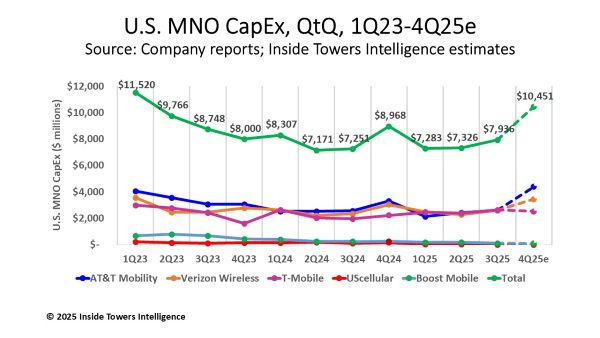
Wireless capital expenditures for 3Q25 among U.S. mobile network operators were over $7.9 billion, according to Inside Towers Intelligence. That figure was up eight percent from 2Q25, and nine percent over nearly $7.3 billion in 3Q24. Year to date, MNOs have collectively spent $22.5 billion, down from $22.7 billion spent in the same period in 2024. Still, MNOs have maintained or raised their full-year capex guidance based on recent developments and are projecting full year guidance of $33.7 billion. The good news: Expect Q4 to ramp up to close that spending gap.
AT&T (NYSE: T) is a big factor here. The company maintained its guidance for the year but within that guidance has shifted its emphasis to wireless, which now accounts for roughly half of the total broadband and wireless capex, according to Inside Towers Intelligence. “We also continue to expect full-year capital investment in the $22 billion to $22.5 billion range, which implies fourth-quarter capital investments up roughly $7 billion to $7.5 billion”, commented Pascal Desroches, AT&T Senior EVP & CFO during the company’s 3Q25 earnings call. That’s a full one-third of AT&T’s full-year budget to be spent in Q4.
AT&T agreed to acquire certain wireless spectrum licenses from EchoStar (NASDAQ: SATS) in an all-cash deal valued at approximately $23 billion. The transaction, announced in August, includes 50 MHz of nationwide spectrum in the 3.45 GHz mid-band (for enhanced 5G capacity and fixed wireless access) and 600 MHz low-band (for improved coverage), spanning over 400 U.S. markets, Inside Towers reported. By leasing the licenses ahead of the final purchase, AT&T says it has already deployed 3.45 GHz on 23,000 of the cell sites in its network.
The deal also allows EchoStar to operate as a hybrid mobile network operator under its Boost Mobile brand via an expanded AT&T wholesale agreement. AT&T will run the RAN portion of the Boost Mobile network to connect Boost Mobile customers; Boost Mobile will maintain its cloud-based core for managing those subscriber relationships. Boost Mobile was on track to invest roughly $500 million in its network in 2025 and has spent $448 million year-to-date, according to Inside Towers Intelligence.
Verizon (NYSE: VZ) maintained its total 2025 fiber and wireless capex guidance of $17.5-18.5 billion. Although the company does not break out its infrastructure capex allocations, Inside Towers Intelligence estimates that the wireless portion to be in the $10-11 billion range, based on previous spending patterns. Verizon still has a lot of C-band spectrum to deploy. The company was the big winner in FCC Auction 107, spending $45.5 billion for 3,511 licenses nationwide.
T-Mobile (NASDAQ: TMUS) raised its full year capex guidance to $10 billion from the previous $9.5 billion. The company said it will spend $2.6 billion to integrate UScellular into its network operations. Moreover, T-Mobile says the integration will take place over two years instead of the original three-to-four-year estimate. We expect the company to maintain that elevated capex level until the integration is complete. At the same time, prior UScellular capex guidance goes away.
Not included in the chart is the quarterly capex of $150-200 million among several dozen regional carriers and independent wireless internet service providers. On top of their annual capex, Inside Towers Intelligence expects a number of these regional carriers and WISPs to receive some BEAD funding to expand their fixed wireless access coverage in small towns and rural markets.
By John Celentano, Inside Towers Business Editor