Public Safety Communications ‘Under Assault’
A recent housing bill passed in Indiana contains a provision that says emergency communications cannot be mandated in new commercial buildings. That law goes into effect this month.
The Safer Buildings Coalition is concerned this kind of provision could spread to other states. Safer Buildings Coalition Executive Director Chief Alan Perdue (Ret.) cited similar laws that have been introduced in Florida and North Carolina to Inside Towers. “We’re trying to make people aware that First Responders need communications,” said Perdue.
Perdue (Ret.) tells Inside Towers the Indiana provision means “there’s no ability to make sure First Responders, police, fire and EMS can communicate inside those buildings. If a building owner wants to do it, they can still do it, but you can’t require it.”
Perdue explains fire codes “have a provision on both the international fire code and the National Fire Protection Association ‘spark code’ that requires you to evaluate a building to determine if your connections work. If they don’t, you have to put in a solution to solve that problem.”
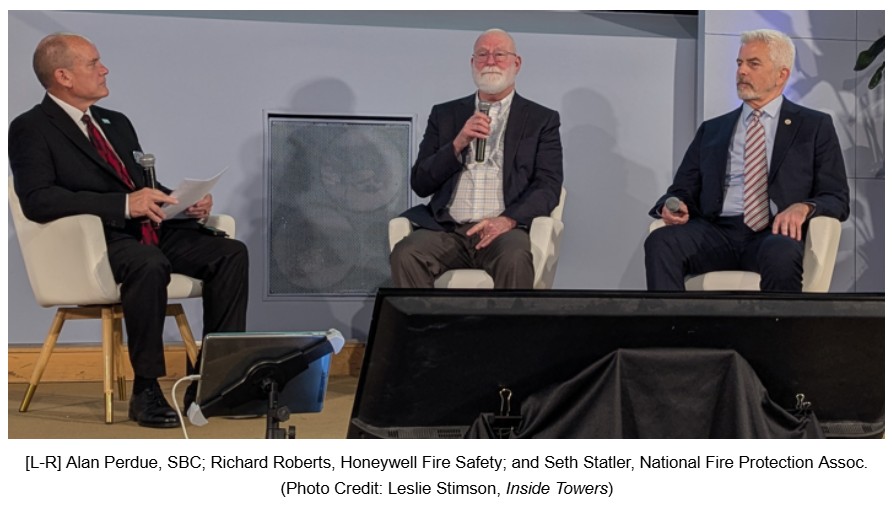
Perdue moderated a panel titled “Public Safety Under Assault: Counteracting the Forces Undermining Codes and Standards” at the Safer Buildings Coalition Wireless Tech & Policy Summit in Washington, D.C. yesterday.
Sources said Indiana sided with builders who wanted to save costs. For in-building wireless, the question is who pays for it. The carriers pay for it in large arenas, for example. But in smaller places, the cost often falls on the neutral host operator or the building owner. If they don’t see ROI they put it off.
Perdue asked the panelists what happens when code enforcement disappears.
Richard Roberts, Honeywell Fire Safety, said that while codes and standards are updated every three to five years from lessons learned from emergencies, implementation is being delayed in many areas. He called that “unconscionable, and we don’t know the consequences of these changes by elected officials until five to ten years later.” He meant more people could die if First Responders can’t communicate in a building during emergencies. “We need to bring together a coalition to fight this,” Roberts said.
Seth Statler, National Fire Protection Association, said “people are not pushing back as loudly as homebuilders and other interests.”
Building the coalition referenced above “is going to take a lot of work,” according to Statler. “You need to get to know the state official who will make those decisions. Take them down into a building and say ‘without the right systems you won’t have communications down there. Use as much data as you can and be a squeaky wheel.’ The time is now to start being a little bit louder.”
Asked for examples of where these efforts have worked at the state level, Statler said Maryland is one of two states that have not changed that code.
By Leslie Stimson, Inside Towers Washington Bureau Chief