

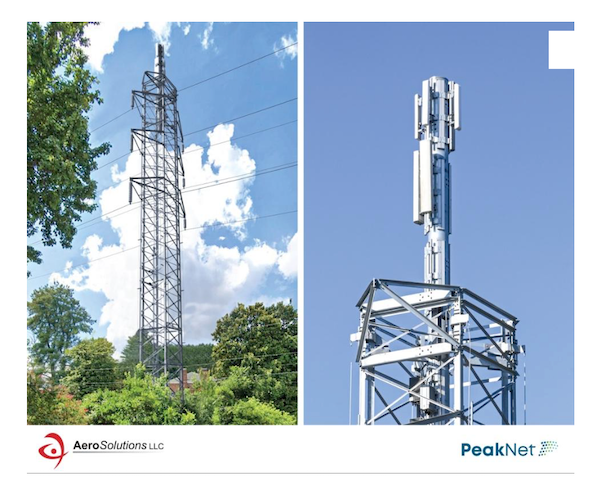
As wireless carriers look for faster, more economical ways to expand coverage and capacity, utility transmission structures present an area of opportunity. The challenge has long been practical rather than geographic: while transmission towers often occupy valuable locations, servicing wireless equipment mounted near energized lines can require scheduled outages, specialized crews and lengthy coordination.
A new concept known as the RAM, short for Retractable Antenna Mast, aims to change that equation. Developed through a collaboration between PeakNet and Aero Solutions, the system is designed to combine the core function of a transmission tower with a movable internal mast that can be lowered for ground-level access to wireless equipment.
According to Jim D. Lockwood, CEO, Aero Solutions, Andrew Chau, Senior Mechanical Engineer, Aero Solutions and Pete Henderson, Manager, Macro Wireless, PeakNet, the goal is to create a more serviceable model for tower collocation while preserving the primary mission of the utility structure.
Cracking a New Colo Code
 For wireless carriers, transmission towers have often represented a location of necessity rather than preference. Henderson said traditional utility attachments can present challenges because carriers generally prefer sites other than those located above energized transmission lines. He said the original objective was to create a way to lower equipment below the conductors so the attachment process would be more comparable to a conventional tower site, thereby reducing the need for programmed outages.
That complexity can carry added costs. When wireless equipment modifications are required on conventional transmission tower attachments, utilities may need to coordinate outages and deploy specially trained crews. Henderson said those requirements increase expenses for both carriers and utilities.
“With the second time they touch that tower as a modification, it’ll pay for itself,” Henderson said of the RAM installation, comparing it with traditional attachment methods.
Lockwood said upfront installation costs may be higher in some cases, depending on the site, but the long-term economics improve as maintenance and upgrade cycles continue.
“Once crews return to the tower for future work, those additional access costs are eliminated,” Lockwood said. He explains the system is designed to allow crews to lower the mast, complete work at safer and more accessible heights, and return the structure to operating position without requiring the traditional outage process.
Engineering a Tower That Moves 
The RAM was developed as a purpose-built replacement or new-build structure rather than a retrofit to conventional transmission towers. Chau described how the internal mast moves within the tower and locks into place once raised.
“The RAM travels up and down within the tower,” Chau said. “There’s a series of locks and latches throughout the stationary tower structure.” He said the system is operated from ground level using a hoist line and pulley system that raises the mast into position.
Once elevated, Chau said latches at each corner rotate into place to support the mast, while clamps apply downward force to secure the structure. “With the latches supporting the mast from underneath and the clamps preventing any upward motion, the mast and tower act as a single structure,” Chau said.
He added that internal working space was a key design consideration. The current square-face tower configuration provides room for technicians, internal hoists, and deployable service platforms intended to improve access during maintenance and upgrades.
The latest version also transitions from traditional angle iron construction to tubular corner legs, a change Chau said improves both mast movement and constructability. “We moved from the traditional construction of angle iron to tubular corners. We see that as a lot simpler and actually stronger for the tower itself,” Chau said.
New Options for Carriers and Utilities
The first live deployment is planned near Asheville, NC, where PeakNet intends to use the system for both Microwave and Land Mobile Radio antennas at a mountaintop location. Henderson said the project is expected to serve as a demonstration site for carriers and utilities evaluating the concept.
Interest has already expanded beyond internal use, with carriers and utilities expressing interest following earlier prototype demonstrations.
“We’re providing the carriers another option to co-locate and expand their network,” Lockwood said. “At the same time, it creates another source of revenue for the utilities.”
For carriers, the appeal may be access to strategically located structures in areas where new monopole or tower siting can be difficult. Henderson noted that utilities already control tower locations in many markets where zoning, land availability, or permitting constraints can complicate traditional development.
Immediate serviceability is another carrier perk, according to Chau. Issues can be addressed quickly and efficiently so there is no delay on maintenance and modifications.
For utilities, the model may also create an additional revenue stream while supporting their own communications strategies, including private LTE and broader network modernization efforts.
Lockwood said the upcoming installation in Asheville is expected to be an important milestone for broader adoption. Henderson said the system is intended to address a longstanding infrastructure challenge with a more practical operating model. “It’s a better way,” he said. “It’s safer, it’s more efficient, and it’s more economical in the long run to do it this way.”
As wireless densification, utility modernization, and siting constraints continue to converge, concepts such as the RAM may offer a new path forward by turning existing utility corridors into more practical wireless infrastructure assets.
For more information on the RAM concept and related infrastructure initiatives, visit Aero Solutions at https://aerosolutionsllc.com/ and PeakNet at https://peaknet.com/.