What’s Happening with 600 MHz?
600 MHz has been in the news lately. AT&T (NYSE: T) is paying EchoStar (NASDAQ: SATS) almost $23 billion to acquire approximately 30 MHz of 3.45 GHz mid-band spectrum nationwide and roughly 20 MHz of 600 MHz low-band spectrum nationwide, Inside Towers reported. A big deal? Maybe.
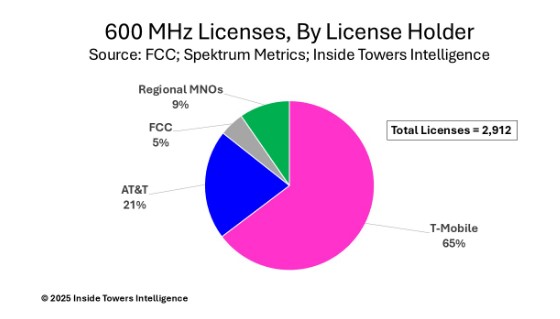
In the aftermath of the AT&T-EchoStar deal and the previously announced T-Mobile (NASDAQ: TMUS)-UScellular acquisition, T-Mobile now controls 65 percent of the 2,912 600 MHz licenses across the country, according to Inside Towers Intelligence. AT&T holds 21 percent while roughly 40 regional mobile network operators around the country hold nine percent. The FCC retains five percent of the licenses that were not sold.
Fifty companies bid nearly $20 billion in FCC Auction 1002 for 600 MHz licenses, concluded in 2017. AT&T spent $910 million, winning 23 licenses, but in 2017–2018, the company sold all those licenses to LB License Co., a subsidiary of Columbia Capital. Verizon (NYSE: VZ) did not participate in that auction. DISH placed second with a $6.2 billion bid. T-Mobile was the big spender, doling out $8 billion and winning 55 percent of the available licenses. Consequently, T-Mobile became the only nationwide MNO using 600 MHz with spectrum depth of around 31 MHz for its Extended Range 5G service.
With the EchoStar deal, AT&T gains roughly 20 MHz of national spectrum depth at 600 MHz. By comparison, AT&T was a big winner in Auction 110 capturing 1,645 3.45 GHz licenses across 406 PEAs for $9 billion. DISH came in second with 1,232 licenses in 406 PEAs for $7.3 billion. With this EchoStar deal, AT&T now controls 71 percent of the 3.45 GHz licenses nationwide with a national spectrum depth of around 30 MHz. The company is fast tracking 3.45 GHz deployments with C-band using dual band radios that only require a single tower climb to deploy both frequencies, thus saving capex.
Originally, 600 MHz was carved out by the FCC’s Broadcast Incentive Auction which ran in 2016–2017, with final results in March 2017, Inside Towers reported. This auction repurposed former UHF TV spectrum into licensed cellular spectrum for mobile network operators. Auction 1002 offered 70 MHz of licensed spectrum in seven 10 MHz blocks (A through G) of 5 MHz uplink (663–698 MHz) paired with 5 MHz downlink (617–652 MHz). Guard bands sit at 614–617 MHz and 653–663 MHz. Lower parts of the UHF TV band (below 608 MHz) are still used for over-the-air television broadcasting.
What will AT&T do with those newly-acquired 600 MHz licenses?
AT&T’s low-band service today relies on 700 MHz (Band 17) spectrum for its 4G LTE/5G cellular network and 700 MHz (Band 14) for FirstNet, its public safety network. 600 MHz spectrum is ideal for wide area cellular coverage, particularly in small town and rural markets because of its long-range propagation characteristics. 600 MHz has better coverage than 700 MHz, although the bandwidth capacity is less.
AT&T has stepped up its mid-band spectrum deployment for handling increasing mobile data consumption and fixed wireless access applications in populated areas. 600 MHz can give the company extended cellular coverage that would likely require fewer towers to achieve the same coverage using higher frequencies, further saving capex. Industry sources tell Inside Towers that AT&T is intending to do just that.
By John Celentano, Inside Towers Business Editor