Why In-Building Wireless Systems Are Important
This analysis is an excerpt from the upcoming Intelligence 2025 Vol 3 issue. For more information or to subscribe, visit: insidetowers.com/intelligence
The justification for implementing in-building wireless (IBW) systems is grounded in fundamental physics: materials such as steel, concrete, and low-E glass, which are prevalent in contemporary commercial construction, significantly attenuate or even prevent outdoor cellular signals from penetrating into interior spaces. The macro cellular network, dependent on external towers and rooftop antennas, is not engineered to ensure consistent coverage within large or densely built structures. Consequently, building occupants frequently encounter dropped calls, areas with no signal, and inconsistent data throughput.
Which buildings are candidates for an IBW system? The U.S. Energy Information Administration’s Commercial Buildings Energy Consumption Survey determined that there are over 5.9 million commercial real estate buildings in the country. While not all buildings require IBW, the segments that do represent a significant market opportunity.
Beyond basic convenience, there are several important roles that IBW systems address:
- Public Safety Requirements: Reliable, in-building public safety communication is vital for first responders. Authorities Having Jurisdiction or AHJs in many communities are now enforcing fire codes requiring public-safety communication coverage, since loss of connectivity during emergencies can be life-threatening.
- Capacity and Performance Demands: High-traffic venues like stadiums and airports need IBW solutions, such as a distributed antenna system (DAS) or small cells to prevent macro cellular network overloading from thousands of simultaneous users at a single venue.
- Enterprise Digital Transformation: Businesses depend on strong mobility and wireless coverage for workflows, IoT, and customer engagement, with sectors like healthcare, education, and manufacturing requiring uninterrupted connectivity.
- Complement to WiFi: IBW systems offer licensed spectrum access and low-latency carrier services, complementing WiFi to deliver more reliable enterprise connectivity.
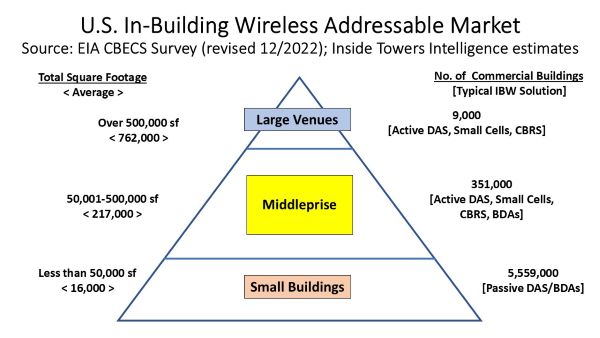
U.S. commercial buildings fall into three categories.
There are around 9,000 large venues over 500,000 square feet, such as stadiums and airports, typically use a DAS systems due to high user density and access by all mobile network operators. Nearly all large venues are already equipped with IBW solutions.
Most U.S. commercial buildings—over 5.5 million—are small, under 50,000 square feet and mainly depend on outdoor cellular coverage or basic signal boosters to receive and send mobile calls indoors. Advanced IBW deployments are uncommon in these spaces.
The so-called middle Enterprise or Middleprise Segment comprises about 351,000 mid-sized buildings (50,000–500,000 square feet). These buildings include offices, hospitals, hotels, and educational and business campuses that are driving IBW market growth in the Middleprise. These facilities need an IBW system but often encounter funding and deployment challenges.
Today, only a small number of Middleprise buildings, just a few thousand by some estimates, are equipped with IBW. At an average deployment cost of $1-$2 per square foot, even single-digit penetration of the total number of buildings could amount to an addressable market of several billion dollars a year.
For a full In-Building Wireless market analysis and more insights, access the full article by subscribing to Inside Towers Intelligence
By John Celentano, Inside Towers Business Editor